
Speed-to-Fly Theory: How Pilots Calculate Optimum Glides Between Thermals
The Invisible Arithmetic of Cross-Country Flight
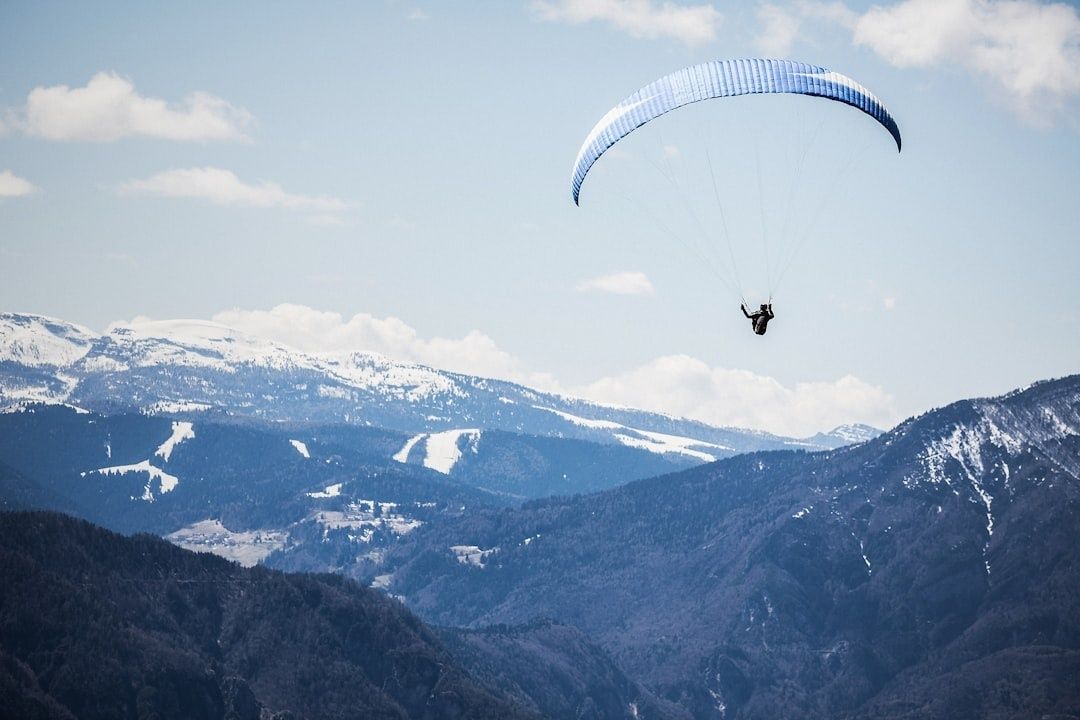
Cross-country paragliding is governed by a negotiation between patience and urgency. In one moment, the correct decision is to circle for another minute in a modest thermal, allowing altitude to accumulate while the valley reorganizes below. In the next, the same instinct becomes expensive hesitation. A broad valley, a shaded gap, or a distant ridge may demand a committed transition before the current climb weakens. Speed-to-fly theory exists inside that tension, turning the glide between thermals into a continuous calculation of altitude, distance, wind, sink, and probability.
Push too hard and the next thermal may be reached with insufficient height to work it. Fly too slowly and the pilot spends precious altitude remaining in sinking air, arriving late or low at the only useful trigger. The theory developed by Paul MacCready for sailplanes offers a disciplined framework, but a paraglider is not a rigid aircraft with a fixed cockpit airspeed. Its polar changes with loading, pitch attitude, harness configuration, turbulence, and pilot input. The practical objective is therefore not to obey an instrument mechanically, but to understand the logic well enough that the canopy, harness, visual references, and variometer begin to express the answer together. For pilots refining their cross-country harness setup, even equipment choices can influence how clearly that feedback is felt.
Deconstructing the Classic Polar Curve in Shifting Air
A polar curve is the aerodynamic portrait of a glider. It describes the relationship between forward airspeed and sink rate, usually showing that the wing descends relatively quickly near stall, reaches a minimum sink rate at a slower intermediate speed, and then sinks progressively faster as speed increases. Glide ratio is derived from the relationship between horizontal speed and vertical descent. The familiar maximum lift-to-drag point, or best glide in still air, is the speed at which the wing travels farthest for each unit of altitude lost.
That description is useful, but incomplete for cross-country paragliding. The air mass itself is moving vertically and horizontally, so the speed that maximizes distance through still air is not automatically the speed that maximizes distance over the ground or preserves the best arrival height. The Federal Aviation Administration”s gliding performance guidance distinguishes minimum sink from maximum lift-to-drag speed and emphasizes that wind, atmospheric vertical motion, weight, and bank angle alter the optimum. In practice, a pilot must mentally shift the polar according to the conditions being crossed.
Headwind and sink both make time less valuable. A headwind reduces the horizontal distance achieved for every second spent flying, while descending air makes every second of the transition actively costly. The tangent from the relevant air-mass condition to the polar therefore touches farther toward the high-speed side. Tailwind and rising air have the opposite effect, although slowing below minimum sink is rarely useful because the canopy may lose authority and the pilot can sacrifice too much controllability for a theoretical gain.
- Still air: Fly near the wing”s best-glide region, subject to the manufacturer”s polar and the pilot”s loading.
- Headwind: Increase speed progressively as the wind penalty becomes dominant.
- Sink: Accelerate enough to reduce time spent in descending air, while preserving control margin.
- Lift: Ease toward minimum sink when the rising air is broad and the next climb is not yet identifiable.
- Mixed conditions: Give priority to the strongest effect, then fine-tune using ground references and canopy feedback.
The MacCready Calculation Simplified for the Cockpit
The central MacCready question is forward-looking: how strong is the next usable climb likely to be? A pilot who expects a powerful thermal can justify a faster transition, because altitude lost on the glide can be regained efficiently. A pilot crossing toward weak, uncertain lift should usually protect altitude and accept a slower speed. The common mistake is setting the value from the thermal just left. A strong climb behind the wing may say little about the shaded valley, blue hole, or wind-exposed ridge ahead.
Modern flight computers translate the selected MacCready value into a recommended speed using the wing”s stored polar. The mathematics is sound, but the stored polar is only an approximation of a flexible canopy in real air. Speed bar changes the wing”s angle of attack and may alter its sink curve; turbulence can make the theoretical speed inappropriate; and a pilot”s ability to control pitch may be more important than a small gain in calculated glide. A useful cockpit approach is to treat the displayed number as a reference band rather than a command.
| Condition ahead | Primary penalty | Typical speed response | Practical priority |
|---|---|---|---|
| Light wind, neutral air | Normal aerodynamic sink | Trim to moderate acceleration | Preserve efficiency and scan for lift |
| Strong headwind | Reduced ground speed | Increase speed bar progressively | Limit time exposed to the wind |
| Moderate sink | Loss of arrival altitude | Accelerate according to severity | Reach better air sooner |
| Strong expected thermal | Low opportunity cost of altitude loss | Fly faster between climbs | Trade altitude for a quicker arrival |
| Broad lift or weak next climb | Time has positive value | Move toward minimum sink | Exploit rising air and remain flexible |
Consider a transition in which the air is sinking gently but a 20-kilometre-per-hour headwind is developing. The pilot may begin at trim, confirm the wind through ground-track movement, then add bar in measured stages. If the wing begins to surge, feel light, or lose pressure in rough air, the correct response is not to defend a target speed at all costs. Ease off, stabilize the canopy, and reassess. Speed-to-fly is a risk-adjusted strategy, not a contest to reach the highest possible indicated speed.
Modern Paragliders Versus Rigid Sailplanes
A rigid sailplane generally preserves its airfoil geometry while accelerating. A paraglider does not. Its ram-air cells, internal pressure, lines, risers, and suspension system form a flexible structure whose shape can change under loading and pitch input. At higher speeds, the polar may degrade asymmetrically: drag increases, the wing can become more sensitive to turbulence, and the ideal theoretical acceleration may no longer correspond to the most efficient or safest flight state.
Rear-riser control adds another layer. Modern wings may offer rear steering bars or rear-riser inputs that allow the pilot to manage pitch and direction without relying entirely on brake pressure. Used delicately, this can stabilize the canopy and preserve internal pressure during accelerated flight. Used aggressively, it can increase angle of attack, generate drag, or provoke unwanted pitch behavior. The objective is to keep the wing loaded, pressurized, and predictable, especially when the air mass is uneven. The STEP X design approach, including rear steering controls and drag-conscious line architecture, illustrates how current wings are developed around active transition management rather than simple trim-speed performance.
Harness aerodynamics matter as well. A cocoon harness can reduce exposed frontal area, improve leg support, and make long transitions less fatiguing. A stable chassis and well-fitted pod also help the pilot detect roll and pitch without fighting the harness. The SUPAIR DELIGHT 5, for example, combines a cocoon structure, carbon seat plate, adjustable stability, and a reduced weight compared with its predecessor. Such features do not magically improve a wing”s polar, but they can help the pilot hold a cleaner posture and make more precise inputs over several hours. In high-performance flying, reduced fatigue is itself an efficiency gain.
- Keep the canopy pressurized before demanding high speed.
- Use acceleration progressively, particularly when entering rough or crosswind air.
- Separate pitch control from unnecessary brake drag wherever the wing”s rear-riser system permits it.
- Judge harness stability by the clarity of feedback, not simply by how firm it feels.
- Remember that a light, efficient system still requires disciplined loading, posture, and active piloting.
The Risk of Instrument Fixation on Glides
Flight computers are powerful, but their advice is inherently delayed. A variometer filters pressure changes to prevent an unreadable stream of noise, while speed-to-fly algorithms depend on a selected MacCready setting, a stored polar, and assumptions about wind and expected lift. By the time an audio prompt announces that the recommended speed has changed, the air mass may already have shifted. In a paraglider, the canopy often registers that change first through pressure in the risers, a small pitch movement, or a change in harness roll.
Physiological feedback is not mystical; it is information from the aircraft. A sudden lightness in the harness can indicate reduced loading or a pitch surge. Increasing tension on one riser may reveal a roll or asymmetric gust. The visual horizon, movement of terrain below, and changing angle to a ridge can show whether a speed increase is actually producing a better ground track. Ground references such as tree lines, towers, ridge edges, and distant roads are especially valuable because they reveal performance over time rather than a single noisy instantaneous reading.
- Start with the air mass. Decide whether wind, sink, lift, or turbulence is the dominant influence before touching the speed bar.
- Make one clear change. Add or release acceleration in a measured step, then observe the canopy, ground track, and variometer trend.
- Protect control margin. If pressure, pitch stability, or visibility deteriorates, slow down even when the computer recommends more speed.
- Use destination logic. Confirm that the chosen speed preserves a realistic arrival altitude and an alternative landing option.
- Review after landing. Compare the flight trace with terrain, wind, and thermal timing to refine intuition rather than merely chase a better number.
Several compact rules work well when the cockpit becomes busy. In neutral air, use trim as a starting point. In a headwind or clear sink, accelerate, but only as much as the canopy and conditions permit. In broad lift, slow toward minimum sink and search actively. If the next climb is uncertain, altitude has strategic value, so do not spend it merely to satisfy an optimistic MacCready setting. These rules are not substitutes for understanding the polar; they are the distilled form of that understanding, designed for moments when calculation would arrive too late.
Mastering the Fluid Geometry of the Sky
Speed-to-fly becomes genuinely useful when it stops feeling like a number and starts functioning as an active mindset. The pilot reads the geometry of the transition: the angle of the ground track, the rate at which terrain approaches, the pressure in the wing, the shape of the clouds, and the likelihood of usable lift ahead. Instruments then sharpen the picture, supplying wind estimates, trend information, and arrival calculations without replacing the pilot”s judgment.
The finest cross-country transitions are rarely the fastest ones in isolation. They are the ones that preserve options, arrive with enough height to search, and spend altitude where the probability of recovery justifies it. Calculated risk means accelerating into a known headwind, committing across a sink line toward a promising ridge, or accepting a lower arrival when the next thermal is credible. Survival gliding means recognizing when the model is wrong and returning to a controllable, conservative speed. Master both, and the valley no longer appears as empty space between climbs. It becomes a fluid geometry that can be read, negotiated, and crossed with purpose.

Comments are closed.