
The Weight of Performance: How to Inspect and Preserve Ultralight Glider Fabrics
The Allure and Engineering Realities of Ultralight Wings
Ultralight paragliders have transformed the practical meaning of performance. A wing that weighs little more than a mountain jacket can make a long approach feel manageable, turn a demanding summit descent into a realistic objective, and reduce the physical cost of repeated launches. The rise of hike-and-fly has accelerated this shift, with compact wings designed for run-and-fly missions, mountaineering, thermaling, ridge soaring, and cross-country use. Models such as Ozone”s Ultralite 5 show how far the category has developed, combining very low listed weights with carefully refined shaping, compact packing, and useful speed.
That efficiency is not free. Lower weight usually means less material, thinner coatings, finer lines, and reduced mechanical reserve. The textile has less protection against abrasion, the line system offers less tolerance for careless handling, and small changes in geometry can become more significant when the original design is highly optimized. Understanding paragliding aerodynamics helps explain why alterations to fabric permeability, line length, or airfoil shape can affect inflation, handling, stall margins, and stability. An ultralight canopy should therefore be treated as a precision aircraft, not simply as a standard wing made smaller and lighter.
Fabric Degradation and the Science of Micro Porosity
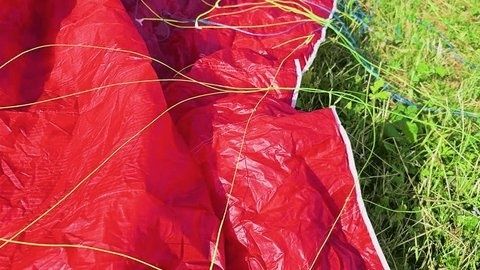
Paraglider fabric must do two jobs at once. It needs to be light and flexible enough to inflate cleanly, yet sufficiently airtight to preserve the internal pressure that gives the airfoil its shape. Polyurethane and silicone coatings close the microscopic gaps between woven nylon fibers. As those coatings age, air begins to pass through the cloth more readily. The change may be invisible to the eye, but it can gradually reduce pressure retention, particularly in areas exposed to sunlight, repeated inflation, dragging, damp storage, or rough ground.
Ultraviolet radiation is especially destructive because it breaks down polymer chains in both coating and fiber. Moisture can accelerate deterioration, while repeated contact with grass, gravel, sand, or alpine rock creates micro-abrasion. Leading-edge sections deserve close attention because they receive direct sunlight and encounter the greatest mechanical stress during inflation and packing. Lower surfaces may appear cleaner while still developing localized permeability around seams, ribs, or frequently folded panels.
A JDC porosimeter turns this gradual process into a measurable diagnostic. The instrument records how long a specified volume of air takes to pass through a defined area of fabric under controlled pressure. The MK2 method uses 0.25 litres of air at 4 hPa through 38.5 square centimetres of cloth. Testing normally samples several points on both upper and lower surfaces, including areas approximately 20 to 30 centimetres inboard from the leading edge. A professional porosity testing service can provide repeatable measurements rather than relying on touch or visual appearance.
- Compare readings from the same locations over time, rather than treating one measurement as a complete diagnosis.
- Pay attention to the lowest readings, not only the average, because localized weakness can be operationally important.
- Record whether the test covers the upper surface, lower surface, leading edge, and representative internal panels.
- Follow the manufacturer”s limits and inspection rules, since general industry figures do not replace the glider”s approved criteria.
JDC readings are often expressed as seconds required for the test volume to pass through the fabric, with shorter times indicating greater permeability. The supplied service information identifies approximately 10 to 15 seconds as a commonly referenced minimum accepted range for both surfaces, but this must not be treated as a universal airworthiness threshold. More permeable fabric can contribute to reduced internal pressure and altered handling, including a greater tendency toward deep-stall behavior in unfavorable conditions. If readings are marginal, inconsistent, or below the manufacturer”s limit, the wing should be referred to an authorized inspector and grounded until its status is clear.
Line Geometry Drift Under Tension and Humidity
Line materials fail in different ways, and ultralight designs often expose those differences more clearly. Unsheathed Aramid, commonly known by the trade name Kevlar, has very low stretch and offers excellent dimensional precision when new. Its weakness is not ordinary elastic elongation but vulnerability to sharp bends, repeated flexing, ultraviolet exposure, and moisture. Internal fibers can fracture while the outer braid still looks serviceable. A line that appears merely fuzzy may already have lost a meaningful portion of its strength.
Dyneema, an ultra-high-molecular-weight polyethylene, is strong, light, and relatively resistant to ultraviolet degradation. It is nevertheless dimensionally complex. Under light loads and low humidity, some Dyneema lines can shrink, while sustained tension may produce creep. Those effects can vary according to construction, diameter, temperature, and loading history. A wing that spends much of its life packed tightly, tensioned during ground handling, or flown at high loading may not retain the exact geometry recorded when it left the factory.
Small dimensional changes matter because a paraglider is a coordinated three-dimensional system. A 10 millimetre difference across a C-line group or a brake fan cascade can alter the local angle of attack, brake travel, pitch response, and stall margin. The effect may be subtle in straight flight and obvious during slow turns, flare timing, or launch inflation. Regular trim checks are therefore not cosmetic tuning. They are a way to establish whether the wing still conforms to the geometry on which its handling and certification behavior were based.
| Material | Primary advantage | Typical concern |
|---|---|---|
| Unsheathed Aramid | Low stretch and precise initial geometry | Fiber damage from bends, abrasion, ultraviolet exposure, and moisture |
| Dyneema | High strength, low weight, and good ultraviolet resistance | Shrinkage, creep, and dimensional change under specific loads and conditions |
| Sheathed line | Improved handling and protection | Greater weight and possible hidden damage beneath the sheath |
Line length information should come from the current manufacturer”s trim table, not from an online diagram or an informal measurement taken under inconsistent tension. Damaged or significantly altered lines should be replaced by a qualified professional using the specified material, construction, and length. Replacing one line with a visually similar component can change cascade balance and load distribution, even when the difference seems negligible.
A Systematic Framework for Pre Season Inspections
A serious pre-season inspection begins with documentation. Gather the glider”s serial number, flight and ground-handling history, previous inspection reports, repair records, and the latest manufacturer trim data. Inspection intervals vary by glider type and use, and some systems refer to annual or flight-hour limits while others permit longer intervals under specific conditions. Owner inspections may also require formal qualification and training. Where those conditions are not met, the work must be performed by the manufacturer or an authorized inspector, with the inspection becoming legally effective only when correctly certified and recorded.
- Backlight the canopy. Spread the wing in even, controlled light and inspect every panel, seam, rib, and diagonal. Look for pinholes, internal diagonal ripstop tears, stretched stitching, cell-wall distortion, and repairs that have begun to lift.
- Inspect fabric by touch and sight. Run clean fingers along exposed areas without dragging the cloth across abrasive surfaces. Note changes in coating feel, unusual softness, brittle sections, contamination, and localized wear near the leading edge.
- Examine the line system. Follow each cascade from riser to canopy. Check unsheathed lines for fuzzing, flat spots, kinks, cuts, discoloration, and signs of core damage. Flexing must be gentle, since forcing a damaged line can worsen hidden fractures.
- Measure trim under controlled tension. Use the manufacturer”s specified procedure and a consistent reference. A precision setup commonly uses 5 daN of tension, but the approved method for the particular glider takes priority.
- Record every delta. Compare measured lengths with the original trim table, identify changes by line group, and preserve the results with the inspection date and equipment used.
The canopy examination should also include risers, maillons or quick links, brake handles, pulleys, stitching, and attachment points. Porosity and tear resistance require calibrated instruments, and visual confidence is not a substitute for either test. A failed reading should not be rationalized because the wing still launches well. The purpose of inspection is to identify deterioration before it becomes a handling problem, not to confirm a preferred conclusion.
Trim data should be interpreted as a system. If several lines in one row have shifted in the same direction, the cause may be material behavior or loading history. If one line is substantially different, the problem may be localized damage, an incorrect replacement, or measurement error. Certification standards provide a useful reference for the design”s tested behavior, but they are not a complete guarantee of how an aged wing will respond in every condition. Manufacturer guidance and qualified inspection remain decisive.
Field Preservation Protocols to Extend Wing Lifespan
Good packing is one of the least glamorous and most effective maintenance decisions. Concertina packing keeps leading-edge sections aligned and reduces sharp transverse creases, particularly in wings using nylon rods or Nitinol reinforcements. A quick-stuff bag is convenient after a long flight, but repeated compression and random folding can create permanent stress concentrations, distort stiffeners, and accelerate coating fatigue. Occasional emergency packing is understandable; making it the default routine is expensive in the long term.
- Keep the canopy off damp grass whenever possible and dry it fully before extended storage.
- Minimize contact with salt spray, sand, dust, and abrasive alpine granite.
- Do not drag the leading edge across the ground, even when repositioning the wing for packing.
- Use clean hands and keep sharp hardware, hook-and-loop closures, and buckles away from exposed cloth.
- Store the wing loosely and dry, away from solvents, fuel, exhaust residue, and prolonged direct sunlight.
Moisture is not harmless simply because it is natural. Damp grass can carry fine grit into the coating, while salt crystals attract moisture and promote surface contamination. Abrasion can remove coating long before a tear becomes visible. After exposure to seawater, rinse only according to the manufacturer”s instructions, avoid aggressive detergents, and allow the canopy to dry completely in shade with good airflow.
Thermal cycling deserves equal attention. A closed vehicle can reach temperatures far above ambient, and repeated heating and cooling may accelerate coating softening, migration, and delamination. The effect is especially relevant to thin ultralight cloth, where the protective layer is already minimized. Long-term storage in a hot car, attic, or sunlit container is therefore a poor trade for a few minutes of convenience.
Mastering the True Maintenance Cost of Flight
The real cost of ultralight equipment is measured not only in purchase price or grams carried uphill, but also in the discipline required to preserve its margins. Saving several hundred grams can make a meaningful difference on a steep approach, yet that benefit depends on maintaining fabric airtightness, line geometry, and structural integrity. A neglected ultralight wing can lose the very qualities that made it attractive while continuing to look broadly intact from a distance.
An aviation-grade maintenance cadence replaces intuition with records. Establish a baseline porosity test, retain the original trim table, log flight and ground-handling hours, and photograph repairs and questionable areas. Arrange inspections according to the manufacturer”s interval and applicable national rules, using an authorized inspector whenever qualification, equipment, or legal status is uncertain. If porosity, tear resistance, line strength, or trim falls outside the approved limits, ground the glider until a competent professional has assessed it.
Responsible retirement is part of performance culture. A canopy that requires repeated repairs, shows broad permeability decline, or has unstable line geometry may no longer offer a defensible safety margin, regardless of how fondly it is regarded. The most capable lightweight pilot is not the one who extracts the final possible flight from aging fabric, but the one who knows when precision equipment has reached the end of its reliable service life.

Comments are closed.