
Before the Cliff: Why Pilots Misread Danger on the Launch Pad
The Quietest Crisis in Mountain Aviation
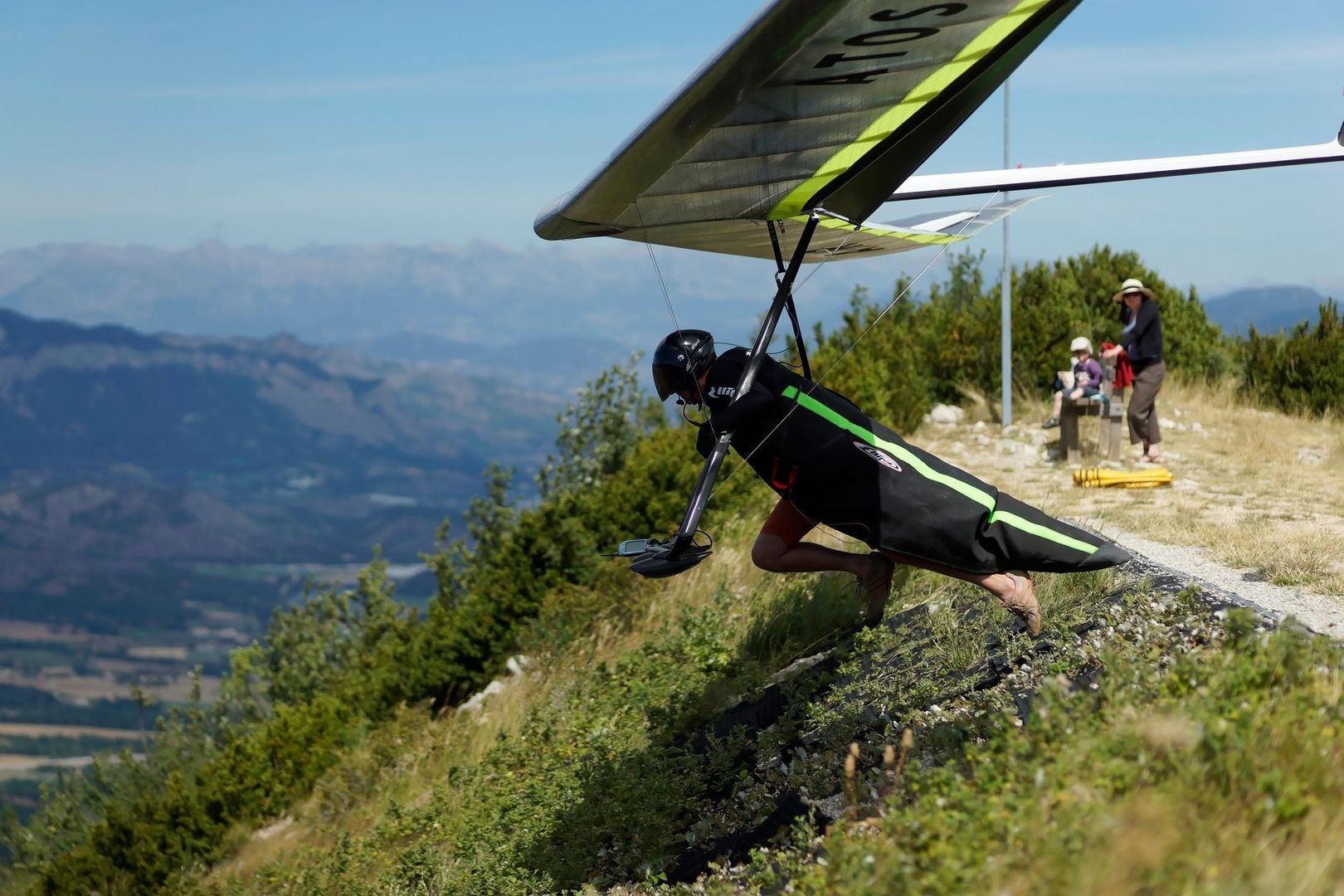
The most consequential moment in a mountain flight may arrive before the wing rises, the engine turns, or the aircraft leaves the ground. On a high launch, danger rarely announces itself with the drama of a collapsing canopy or a sudden loss of control. It appears instead as a collection of small discrepancies: wind that is stronger than forecast, thermic cycles arriving too sharply, a rotor line visible only in the movement of distant trees, or a pilot who feels unusually determined to go. The launch pad is quiet, but it is not psychologically neutral. It is where information, ambition, fatigue, group momentum, and uncertainty meet.
That is why a sound paragliding safety mindset must begin before the first control check. In the air, a pilot often recognizes an emergency because the aircraft provides immediate, physical feedback. The response may be fast, imperfect, and highly trained, but the problem is visible. On launch, by contrast, the mind can turn ambiguity into permission. A marginal cycle becomes “probably workable.” A gust becomes “normal for this site.” A difficult approach becomes an investment that must not be wasted.
Human factors contribute to approximately 80 percent of aviation accidents, according to the FAA”s aeronautical decision-making guidance. On high ridges, those factors often take the form of social pressure, selective attention, overconfidence, and a reluctance to disappoint the group or oneself. Walking down is therefore not a retreat from aviation. It is a calculated act of mastery, a decision to preserve judgment for the flight that deserves it.
The Psychology of the Precipice
Experienced pilots do not usually make launch decisions by building a perfect spreadsheet of every possible outcome. They use naturalistic decision-making, a process shaped by experience, pattern recognition, and time pressure. Gary Klein”s recognition-primed decision model describes how an operator recognizes a familiar situation, identifies a plausible response, and mentally simulates whether that response will work. This is efficient when the pattern is correctly identified. It becomes dangerous when a new situation resembles an old one only superficially.
A pilot may recognize a familiar valley breeze, a launch cycle, or a cloud base and feel an immediate answer forming: prepare, inflate, fly. Yet the body may register information the conscious mind is discounting. Breathing becomes shallow, attention narrows, or the hands hesitate during ground handling. Such somatic signals are not infallible, but they deserve examination. The problem begins when the desire for action converts them into obstacles to be overcome. At that point, objective hazard assessment gives way to rationalization, with every inconvenient fact absorbed into a story about why the flight should still proceed.
Heuristic Traps Waiting on the Turf
Launch sites are social environments, even when nobody is speaking. One pilot clips in, another follows, and a third begins laying out a wing. Each action supplies apparent evidence that the conditions are acceptable. This is social proof, a shortcut that substitutes the behavior of others for an independent assessment. It is especially potent when the pilots nearby are admired, more experienced, or visibly confident. Their decision may reflect a different wing, skill set, objective, or tolerance for consequence, but those distinctions can disappear under group momentum.
Commitment bias adds a second layer. A demanding approach hike, heavy equipment, a long drive, a booked weather window, or a rare opportunity to fly can make stopping feel disproportionately costly. The effort already invested begins to influence the assessment of what happens next. Alpine and polar safety training commonly identifies related traps such as familiarity, conformity, scarcity, the Expert Halo, and social proof. These are normal cognitive tendencies, not character defects, which is precisely why they require deliberate countermeasures.
- Social proof: others are launching, so the conditions must be acceptable.
- Commitment: the time, effort, or money already spent seems to demand continuation.
- Familiarity: a known site creates confidence even when the weather pattern has changed.
- Expert Halo: a respected pilot”s decision is treated as a safety guarantee.
- Scarcity: the thought that this may be the only launch window encourages rushed judgment.
- Conformity: a pilot suppresses concerns to avoid appearing timid or inexperienced.
The Mirage of Normalizing Risk
Will Gadd”s reflections on the Red Bull X-Alps expose how quickly a risk boundary can move. Conditions that would be plainly unacceptable for an ordinary recreational pilot may be treated as part of the event”s operating environment. The race exists at the edge of endurance, skill, logistics, and competitive pressure, and its participants are highly selected athletes. Yet the visible spectacle can make exceptional behavior look like a transferable standard.
The distinction matters. An elite pilot operating within a specialized competitive system may have deeper weather knowledge, greater physical capacity, extensive preparation, and a different relationship with consequence. Even then, elite status does not make danger disappear. Gadd”s account points to Max Pinot”s withdrawal in dangerous conditions as an example of clear-eyed judgment, not weakness. The decision acknowledged that continuing could be incompatible with an acceptable level of risk, regardless of reputation or competitive cost.
Recreational pilots face a further trap after surviving a questionable launch. Nothing goes wrong, the flight becomes memorable, and the outcome is stored as evidence that the decision was sound. This is outcome bias. A favorable result does not prove that the original risk calculation was good; it may simply mean that the hazard did not produce its worst consequence on that occasion. Repeated survival can normalize a narrowing margin until an ordinary variation in wind, timing, or attention exposes the flaw.
A Tactical Launch Pad Decision Matrix
A structured Aeronautical Decision Making process helps separate observable conditions from the stories attached to them. The FAA describes risk management as a cycle of identifying hazards, assessing risk, selecting controls, implementing them, and monitoring whether they remain effective. For mountain pilots, the same logic can be condensed into a launch matrix that is simple enough to use under pressure. The purpose is not to produce false precision. It is to prevent one exciting variable from eclipsing several quiet warnings.
| Domain | Green indicators | Amber indicators | Red indicators |
|---|---|---|---|
| Physical | Rested, hydrated, warm, and capable of precise ground handling | Fatigue, cold, hunger, minor illness, or reduced concentration | Shaking, dizziness, severe fatigue, injury, or impaired coordination |
| Environmental | Wind within personal limits, stable cycles, clear escape options | Gust spread increasing, thermal turbulence, changing cloud or wind direction | Rotor, strong crosswind, rapidly deteriorating weather, blocked escape route |
| Technical | Equipment checked, correct configuration, launch and landing rehearsed | Minor equipment uncertainty, unfamiliar setup, rushed preparation | Unresolved defect, tangled lines, unsuitable wing, or inadequate launch margin |
| Mental | Calm, attentive, willing to wait or walk down | Pressure to perform, frustration, fixation on the window | Fear being suppressed, anger, competitive urgency, or “must go” thinking |
Objective micrometeorology should lead the decision. Wind direction at the launch, gust spread, cycle quality, rotor indicators, cloud development, and the usable landing zone are measurable or at least observable. Ego-driven excuses sound different: “Everyone else is going,” “The hike was too long to waste,” or “The first thirty seconds will be fine.” A useful test is to remove the audience and the sunk cost. If the same conditions appeared at a new site with no social pressure, would the flight still be accepted?
The Protocol for Unclipping Without Ego
Unclipping is easiest when the decision has been made before emotions intensify. Establish personal boundaries during planning, including maximum wind, acceptable gust spread, crosswind limits, turbulence tolerance, visibility requirements, and a clear rule for deteriorating cycles. If conditions move beyond those boundaries, the decision is procedural rather than personal. The American Alpine Club”s guidance on risk management similarly emphasizes hazard inventories, pre-mortems, honest self-assessment, and reflection on what could be done differently.
- Pause the sequence. Stop laying out, clip out, and place both feet firmly on the ground. Physically interrupting the launch routine creates space for a fresh assessment.
- Name the trigger. State the specific reason for stopping, such as increasing gust spread, rotor, fatigue, equipment uncertainty, or a compromised escape route.
- Check the boundary. Compare the observation with the preselected limit, not with another pilot”s tolerance or the emotional value of the day.
- Use neutral language. Say, “Conditions are outside my limits, so I am standing down,” rather than inviting debate with a vague claim that the launch feels difficult.
- Create a go-around mindset. Treat walking down, waiting, or relocating as the planned alternative, not as an embarrassing failure.
- Review without self-punishment. Record what changed, which cue appeared first, and whether the original plan needs adjustment for future flights.
Standardized language helps de-escalate launch-pad tension. A group that hears “I am outside my limit” has less room to turn the decision into a referendum on courage. The same principle applies to light-aircraft mountain operations, where formal training in decision-making, risk management, and alpine flight planning treats conservative choices as part of competent operations. A disciplined hike down protects more than the current day. It preserves confidence in one”s own boundaries, which is essential for long-term airmanship.
Mastering the Courage to Walk Down
True airmanship is not measured by the number of dramatic launches survived. It is measured by the quality of judgment applied before the aircraft becomes committed to the environment. A pilot who can distinguish weather information from social theatre, and bodily caution from performance anxiety, has developed a skill more durable than bravado. Restraint is not the absence of ambition. It is ambition governed by consequence.
The immediate decision to abort should never be allowed to define personal identity. You are not less of a pilot because a mountain, a wind cycle, or a particular day falls outside your margins. The stronger culture is the one that celebrates accurate forecasts, honest callouts, thoughtful waiting, and the quiet competence of walking down. In that culture, the launch pad becomes what it should have been all along: not a test of nerve, but the first place where sound judgment takes flight.

Comments are closed.